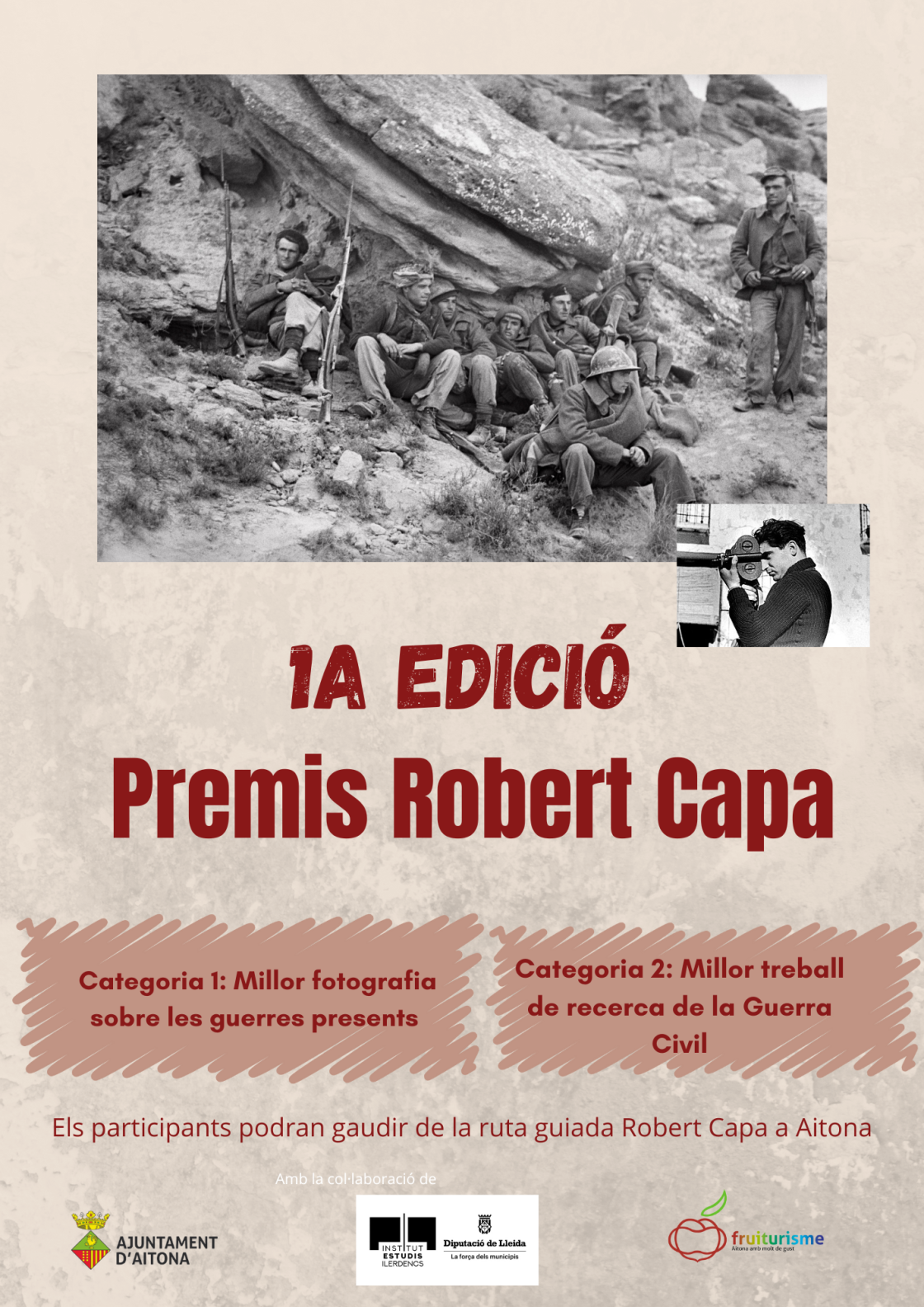
ROBERT CAPA AWARDS
AIM
To honor historical memory by increasing scientific knowledge of the Civil War in the Lleida region.
The 1936 coup d'état was the beginning of a civil war that, for three years, devastated Spanish and Catalan society. The civilian population suffered the hardships of a brutal war: broken families, hunger, bombings, death, injuries, exile, repression… The Republican defeat at the Battle of the Ebro led to the fall of Catalonia. Subsequently, exile and repression marked a cruel beginning for Catalonia.
Robert Capa documented the Republican offensive in Aitona on November 7, 1938. Surely, further documentation of the Segre Front can be done to continue building the narrative of the Civil War in our territory.
From the Aitona town hall and the Institut d'Estudis Ilerdencs we are looking for studies that build this history and fill possible gaps and voids in the overall narrative.
The Capa Awards aim to highlight people, documents and works that contribute, in this aspect, mainly to the Segre Front of the Spanish Civil War.,
The second objective is to honor the pioneering war photojournalist of the 1930s, Robert Capa, pseudonym of Ernö Friedmann. He produced a splendid report on the Republican army's attack on Aitona and the Serrabrisa area in the Lower Segre region. A daring photographer who, over the years, established himself as one of the best.
Two categories are established according to the areas we consider essential and necessary to keep the memory alive. These include historical research from different perspectives: journalistic, documentary, etc., and the dissemination of content related to the Segre Front in particular, and to the Civil War and its effects on Catalonia in general; and images: photographs that identify conflict zones as a reflection of cruel wars and their effects on society.
CATEGORIES
1. Prize for the best auteur photograph on current wars, endowed with 2,000 € and commemorative trophy
Specific bases
Participants may submit a maximum of two color or black and white photographs. Photomontages or retouched photos will not be accepted.
The submitted images cannot be more than two years old from the date of the announcement of these awards and cannot have won in other competitions or awards.
Submissions must include the name, NIF (Spanish tax identification number), address, telephone number, and email address of the author(s).
Interested individuals or legal entities may submit their work in digital format (JPG or high resolution photographs) by sending it via email to: capa.aitona@ajuntamentaitona.cat or in paper format to the Aitona Town Hall before September 15, 2024.
The size of the images, if submitted to the town hall, must be 30 x 40 cm. Photographs will be returned to the authors if they are not awarded a prize.
Participants will provide a declaration of responsibility in accordance with European regulations, specifying that the images presented are not created by any artificial intelligence system or technique to distort the real image.
The jury may declare the prizes void or add an honorable mention or commendation, as well as resolve any unforeseen circumstances not covered by these rules.
The Aitona town council will acknowledge receipt of the works and will only contact the winners and finalists.
The winning image and the finalist images will be part of a temporary exhibition for six months from the awards ceremony in the municipal space designated by the town hall. Afterwards, the images can be collected by the photographers at the Aitona town hall.
Award winners will not be eligible to apply for the Capa Awards again until two years have passed since the award ceremony.
2. Prize for the best research paper on the Civil War, endowed with 2,000 € and commemorative trophy
Specific bases
Participants may submit only one research paper, which may not exceed 100 pages.
The works must be submitted printed on one side only (DIN-4 vertical) or in digital format (horizontal presentation may be used when required by tables, graphs, photographs, etc….).
MarginsTop and bottom: 2.5 cm. Left and right: 3 cm.
Format: Font. Preferably, a single font type should be used (Times New Roman, Arial, Calibri, Trebuchet are recommended) and according to the following thicknesses:
Qualification: thickness 14 bold. Text: thickness 12 normal
Footnotes and legends for tables and figures: normal thickness 9, or the one that corresponds to the chosen letter or set by the program configuration.
Paragraph: Alignment: Paragraphs should be justified on the right and left margins.
Line spacing: single spacing within the paragraph body and 1.5 spacing between paragraphs.
Spacing: automatic or 0 points.
Page numbering: in the same font that is being used, located in the central or lower right part of the page.
Tables and Figures: numbered consecutively with Arabic numerals. They will be inserted into Word, even if they were created with other programs.
Footnotes: They will be inserted on the same page as indicated, with consecutive Arabic numerals.
The submitted works cannot be more than two years old from the date of the call for these awards and cannot have been winners in other competitions.
Participants will provide a declaration of responsibility in accordance with European regulations, specifying that the submitted works are not produced by any artificial intelligence system or technique.
Submissions must include the name, NIF (Spanish tax identification number), address, telephone number, and email address of the author(s).
Interested individuals or legal entities may submit their work in electronic format by sending it via email to: capa.aitona@ajuntamentaitona.cat or in paper format at the Aitona Town Hall before September 15, 2024.
The Aitona town council will acknowledge receipt of the works and will only contact the winners and finalists.
The Jury may declare the prizes void or add an honorable mention or commendation, as well as resolve any unforeseen event not covered by these rules.
ELIGIBILITY CRITERIA
The relevance and originality of the proposal, the coherence and rigor in the methodology of the Works and the contribution and advances of the studies in historical memory will be valued.
JURY
The Aitona Town Council will appoint a jury of up to six people, comprised of experts in the field. The jury president will be Mr. Josep Maria Solé Sabaté (PhD in Contemporary History, UAB). The director of the Institut d'Estudis Ilerdencs and the town councilor for heritage will serve on the jury in both categories. The secretary will be the same as the town council secretary.
In the first category, the jury will consist of Sandra Balsells (photojournalist), Francesc de Dios Sans (journalist and representative of the Lleida College of Journalists), and Roser Vilallonga Tena (press photographer). They will evaluate the submissions and select the winner and six finalists. The deadline for deciding the winners is October 30, 2024. The results will be announced on social media, the website, and in Lleida media outlets, and will be published in the BNDS (National Library of Spain).
In the second category, the jury will also include Mr. Manel López Esteve (professor of the area of contemporary history of the Departament d'Història of the UdL) and Ms. Anna Esteve (archivist and historian).
The winners and finalists will be announced on November 7th by the president of the jury and the award ceremony will be held before December 4th.
The town council and the Institut d'Estudis Ilerdencs will have the right to publish, disseminate, and promote the winning entries, provided it is for the purpose of promoting the Capa Route, the Robert Capa Days, and future editions of the Awards. Should the authors publish their work, they must acknowledge and reference the award granted by the Aitona town council and the Institut d'Estudis Ilerdencs.
All prizes are subject to applicable tax laws.
Participation in this competition implies full acceptance of the rules and the jury's verdict.
Attendance at the awards ceremony is mandatory for all winners. During the ceremony, the winners will have the opportunity to present their work and explain the process they followed in its creation.
During the event, the jury will also explain their assessments of the winning works and how these contribute to historical memory and their importance in society in general, by reading the minutes of the session.